Outsourcing Meat Production to China

polyface farm

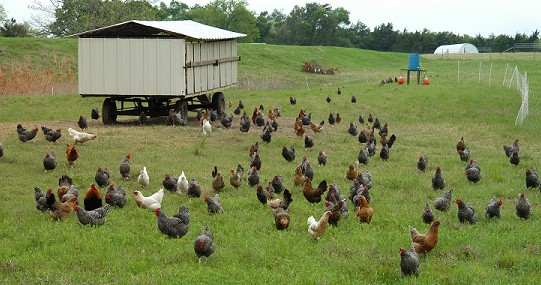
While out searching for farmland one day, I encountered an elderly woman at the bus stop and struck up a conversation with her. When our conversation turned to farming, she recalled that she used to grow vegetables and raise chickens, and that this practice significantly reduced the amount of pests she had to deal with. The chickens pecked at the ground, eating the pests, and the seeds (and roots) of weeds. By simply feeding themselves, the chickens helped her to dramatically reduce pest and weed problems without  using any chemicals!

In the past, many farmers also raised pigs that were fed with plant waste. This created another win-win situation. The plants and parts of plants that humans didn’t or couldn’t eat were used to fatten up pigs. Plant waste was recycled as pig feed. Kitchen waste (that now makes up 40% of the garbage going to our landfill) was also turned into pig feed. According to the SCMP, the recent increase in the garbage going to our landfill can partly be attributed to the reduction in the number of pig farms in Hong Kong. Continue reading “Outsourcing Meat Production to China”

Paper Books vs. Online Content

google-data-centers-10

This article will explore the widespread belief that e-books and online content is environmentally more friendly than hard copy paper books. First, however lets take a look at the history of technology.

The invention and adoption of every technology is a response to a problem that existed in the past. Today, we tout the coming age of (clean energy powered) electric or hybrid cars as solution to reducing the fossil fuel consumption, air pollution and CO2 emissions caused by internal combustion engine powered cars. The car however was itself a response to an even earlier environmental problem – the vast amounts of manure on city streets caused by the horse and buggy.

At the time of the invention of the internal combustion engine, no one considered CO2 emissions or climate change to be a problem. This illustrates the law of unintended consequences. We cannot foresee all the environmental impacts of technology, let alone foresee how it will be used. The internet is prime example, invented by the military for fast, secure communications, it has become a worldwide tool for commerce, social interaction and political movements (as well as porn, online gambling and Facebook poking).

The proliferation of this technology has resulted in enormous data centres, communication networks and billions of end user devices (computers, iPads, iPhones) consuming vast amounts of energy. According to Yale, Since 1990, household energy consumption has been rising worldwide at 3.4 percent a year, in large part because of the rapid spread and increasing sophistication of electronic devices. At this rate, household energy consumption doubles every 20 years.

Lets compare the environmental impact of the production, transportation, use and disposal of paper versus electronic content. Remember, all electronic content is stored on and accessed through electronic devices. This is the elephant in the room. Continue reading “Paper Books vs. Online Content”

Why is organic food so expensive?

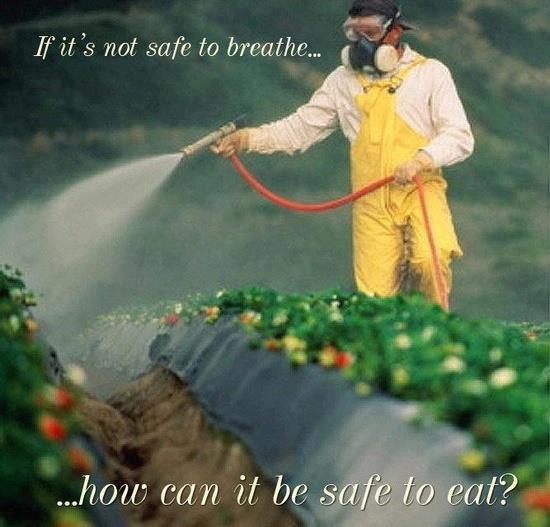
Spraying Strawberry

As an organic farmer, I am often asked “Why is organic food so expensive?”

The simple answer is that it’s not. It is that conventional (chemical) food is cheap. Or more accurately, the price of conventional food does not reflect its true cost. Let me explain:

The introduction of chemical fertilizers, pesticides and herbicides dramatically increased yields and lowered labor input costs, thereby decreasing the price of food. However, they also imposed costs that are not reflected in the price consumers pay for food, what economist call externalities.

Chemical fertilizers are cheaper and more potent than organic fertilizers, resulting in widespread overuse. The use of these highly concentrated fertilizers has created vast dead zones in our oceans, rivers and lakes. This is a cost, but we as consumers don’t pay for it. To grow an equivalent amount of food, organic farmers need to transport and spread much larger quantities of slow-release, low concentration fertilizer on their fields which results in increased labor costs that is paid for by the consumer.

Chemical pesticide and herbicide use is contaminating ground water worldwide. Atrazine, one of the world’s most widely used pesticides, wreaks havoc with the sex lives of adult male frogs, emasculating three-quarter of them.  So while the price we pay for conventional food is cheap, the cost to the environment is not. Without chemical pesticides, organic farmers suffer greater crop loss from pests. Since consumers will not accept blemished fruits and vegetables, organic farmers end up with significantly less salable produce. Hence, they need to sell the salable produce at a higher price in order to survive.

Finally, there is no such thing as organic herbicides, so the organic farmer must manually or mechanically remove weeds. This again, increases the cost of production and needs to be paid for by the consumer. Continue reading “Why is organic food so expensive?”

The Library 2.5

This book sells for HK$400 at Dymocks. With a few clicks I had it delivered to my neighborhood library for HK$2.50 and kept it for over 2 months for free.

SERVICE RATING Awesome. The public library’s selection is unparalleled and vastly superior to those of Hong Kong’s closet-sized bookstores. The online search, reservation and renewal functions work great. The reservation function allows you to have a book delivered, no matter which branch it’s currently in, to the one closest to you. There are after hours book return drop boxes outside every branch and at Central, Kowloon Tong and Nam Cheong MTR stations.

GREEN RATING Deep Green. Much greener than buying a book you’ll likely only read once and infinitely greener than downloading books to your Kindle or iPad (explained below).

OPENING HOURS and LOCATIONS here

The US media has proclaimed the sharing revolution to be the next big thing. From Zipcar to Netflix it’s taking hold all over the US. The public library though has been sharing since forever.

BORROWING VS. OWNING

Buying books has three distinct disadvantages that borrowing from the library overcomes. Often times you simply don’t know if a book is good or not. Just like you wouldn’t commit to marrying someone after a first date, you probably don’t want to commit to spending the time and money to buy and read a book after only perusing a few page. Second, once you own it, it ends up taking up precious real estate in your space deprived Hong Kong apartment. Lastly, it’s a pain to pack up every time you move. For me, these practical drawbacks simply outweigh any psychic pleasure I gain from owning a book.

ENVIRONMENT

Many trees are chopped down in the process of making books while much fossil fuel is burned transporting them. It is often suggested that iPads or e-readers, such as Amazon’s Kindle, offer a solution. Unfortunately, these devices and the gear that supports them are an environmental disaster. The environmental impact resulting from the manufacture and disposal of electronics, which are replaced on average every 3-4 years, has been well documented. According to Time, “A lot of exported e-waste ends up in Guiyu, China, a recycling hub where peasants heat circuit boards over coal fires to recover lead, while others use acid to burn off bits of gold. …Guiyu has the highest level of cancer-causing dioxins in the world and elevated rates of miscarriages.”

A hidden but no less damaging consequence of the online revolution has been the massive amounts of energy consumed to run all that high tech gear. Data centres, networks and PCs collectively consume unbelievable amounts of electricity. At a PolyU Energy and Environment conference I attended, one of speakers asked the audience the following question “What is the best option [from an environmental perspective] of transporting a dozen books from Australia to Hong Kong within 24 hours: (a) ship them via air, (b) download them to your e-reader or (c) burn them onto some disks and then ship them by air? As you probably guessed, it turns out to be (c). What is surprising though is that (a) actually has lower carbon emissions than (b) due to all the energy required to run data centres and networks 24 hours a day and move data at lightspeed. Continue reading “The Library 2.5”

An Inspirational Guide to Building an Environmentally Sustainable Business

TITLE Let My People Go Surfing. The Education of a Reluctant Businessman

BOOK RATING An inspiring and useful guide for those seeking to build an environmentally sustainable business.

GREEN RATING Deep Green. Book is printed on Forest Stewardship Council (FSC) certified and recycled paper.

AVAILABLE AT Can be reserved online and sent to a public library near you for HK$ 2.50

For those who haven’t heard of Patagonia, there is a very good reason why: it simply does not promote its outdoor apparel to people that do not need them. This business philosophy stands out when the Timberlands and North Faces of the world are hawking their outdoor gear to city slickers that will use them mainly in the extreme conditions of IFC or Festival Walk. Patagonia’s products on the other hand are highly sought after by true outdoor enthusiasts.

This book by Patagonia founder, Yvon Chouinard,  is truly a refreshing change from business books written by egomaniacs like Jack Welch and Donald Trump or by out of touch ivory tower academics. The title “Let My People Go Surfing” refers to the company flex-time policy that when the surf is up, you can drop what you’re doing and go surfing so long as you get all your work done properly. It is structured broadly into 3 sections: (1) “History” which reads like an autobiography; (2) “Philosophies” of product design, production, distribution, image, finance, human resources, management and environment provides practical guidelines enlivened by great stories; and (3) “1% For the Planet” which discusses the companies philanthropic initiatives.

Here are just a few examples makes Patagonia a Deep Green company:

1. It was the first company to recycle plastic drink bottles into fleece. Chouinard writes: “At the time of our fiber study, we were manufacturing a lot of fleece jackets made from virgin polyester, the only kind of polyester available. So we worked with a company called Wellman to find alternatives. They developed a process that takes soda pop bottles, which are also made of polyester, and recycled them into raw material for jackets. It takes 25 bottles to make a jacket, and from 1993 to 2003 we diverted 86 million soda bottles from landfills. For every 150 virgin polyester jackets that we replaced with post-consumer recycled polyester, we saved 42 gallons of oil and prevented a half ton of toxic emissions.”

2. Patagonia completely phased out the use of conventionally grown cotton in 1996. After visiting a cotton farm, Chouinard realizes the devastating effect of cotton farming on the land. Chouinard writes, “today 25% of the annual worldwide insecticide use and 10% of of the annual worldwide pesticide use are applied to conventionally grown cotton, even though cotton fields occupy less than 3% of the world’s farmland. Many of these chemicals were originally formulated as nerve gases for warfare, so it’s no surprise the higher rates of birth defects and cancer have been found in both humans and wildlife surrounding cotton fields.” Continue reading “An Inspirational Guide to Building an Environmentally Sustainable Business”

Are Those Veggies Safe to Eat?

At the supermarket, I usually see an abundance of fresh, flawless vegetables. The vegetables are uniform in size and shape, and completely untouched by insect marks of any kind. As a organic farmer though, I can attest to the voracious appetite of nature. I have seen lettuce leaves pecked clean by birds, cabbages and corn devoured by insect larvae, cucumber and tomato plants infected by disease, and many crops damaged by slugs, snails and beetles.

In conventional farming, the solution is to apply vast quantities of pesticides. Pesticides are substances that prevent or destroy insects, weeds, and diseases that affect crops. This is chemical warfare against nature. In fact, many modern pesticides are chemically similar to chemical warfare agents developed during WWI and WWII.

For example, organophosphates are the basis of many insecticides, herbicides (that are approved for agricultural use) and nerve gases. According to wikipedia “They are of concern to both scientists and regulators because they work by irreversibly blocking an enzyme that’s critical to nerve function in both bugs and people. Even at relatively low levels, organophosphates may be most hazardous to the brain development of fetuses and young children. They can be absorbed through the lungs or skin or by eating them on food”.

The “safety” of approved pesticides is also commonly compromised by misuse. Farmers may apply more than the recommended amount or they may apply it too close to harvest time. Imagine you are the farmer, and your crop will be harvested in the next two weeks. Months of hard work are about to pay off! But then you see those pesky insects leaving their bite marks on your crop. Do you spray the insecticide, even though the instructions  say “do not spray within 14 days of harvest” or do you simply refrain from spraying and accept that you will earn significantly less or sustain a loss from your now insect damaged crop? Continue reading “Are Those Veggies Safe to Eat?”

Article in SCMP about ADOPT ME

Green-living lawyer with a brief to save the planet

She hasn’t bought a new outfit for 18 months and sets an example by wearing wardrobe cast-offs

Intellectual-property lawyer Rachel Pang Hoi-yan has not bought a new outfit for a year and a half.But that does not mean she lacks new clothes for work or casual activities. On the contrary, near-new fashion and accessories keep coming in.Pang has become the fashion equivalent of an animal-rescue agency, taking in abandoned wardrobe items – of which the owners have tired. But unlike some businesses that trade in second-hand brand-name accessories, her service is free.”This black pullover I am wearing is an abandoned one, and so is this handbag,” said the green-living enthusiast. “This is the first time I have had a made-in-France handbag. There is no way to tell it is second-hand.”Her new role began with a message she put on MSN asking for second-hand clothes.

“My friends reacted strongly, asking if I was serious about it,” she said. “I told them I was. Several weeks later, a friend’s friend gave me a suitcase of clothes, including the suitcase. All close to brand-new.”

The lawyer has no idea how many abandoned clothes have reached her, how many she has given out or how many she still has. She started advertising the clothes on Facebook several months ago but has since moved the adverts to her blog that promotes low-carbon living.

Pang and her husband have practised green living in recent years, renting 7,000 sq ft of land where they farm organically. Their food is usually plant-based because growing vegetables consumes far less energy than producing meat.

She also furnishes her home with previously owned furniture and electrical appliances supplied by people who do not need them.

“It is easy to tell people to protect the environment but it is difficult when it comes to practice,” Pang said. “If we are serious about protecting the environment and making it the philosophy of our life, it will have a profound impact on every aspect of our lives.” That’s why, she says, there are people who still refuse to acknowledge climate change.

Pang thinks Hong Kong is designed to encourage consumption, leading to a wasteful lifestyle. Continue reading “Article in SCMP about ADOPT ME”

Launch of Go Green Hong Kong!

Welcome to the launch of Go Green Hong Kong!

Go Green Hong Kong! is here to help you discover eco-friendly products and services that are available right here in Hong Kong. This is a new way to help protect our home, planet Earth, simply by doing the things we do – eating, shopping, enjoying life – in a eco-conscious way.

We provide independent, unpaid reviews of green restaurants and products. We try out every restaurant or product ourselves and evaluate it from both a consumer and environmental perspective. To learn more about our rating criteria, please go to About.

Each week, we’ll bring you reviews of eco-friendly household products, personal care items, clothing, accessories, food and restaurants. We’ll also keep you up-to-date on green events and activities happening right here in Hong Kong. Continue reading “Launch of Go Green Hong Kong!”