


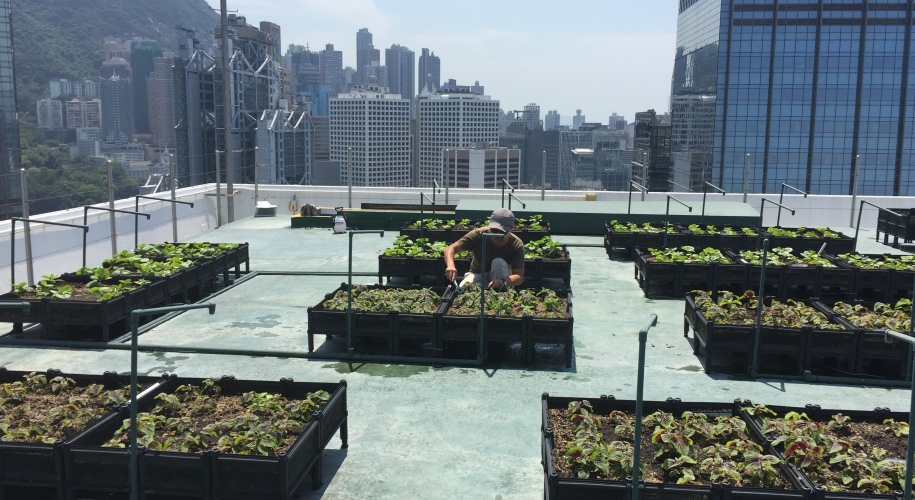


Bokashi: Dealing with Kitchen Waste

PRICE HK$ 399 for the system and 1 bag of the micro-organism (lasts 1 to 2 years).
PRODUCT RATING Good only if you have a place to bury the “compost”. This system is imported from Australia (where many homes have backyards) so it’s not very suitable for Hong Kong apartment dwellers.
GREEN RATING Quite Green. By separating kitchen waste, we went from throwing out 3 to 4 bags of garbage per week to only 1 per week.
AVAILABLE AT Greeners Action
We were initially quite excited to learn about the kitchen waste “composting” program at Park Island. Residents can pick up plastic container from the doorman, fill it with kitchen waste and return it to the doorman. Our understanding was that it would be processed by an on site kitchen waste “composting” machine and we naively assumed the compost would be used in the surrounding gardens. After attending a residents meeting, we learned that the compost was not used in the gardens because landscaping was outsourced to a company that did not use compost. We soon learned that it was actually being released to the sewage treatment plant. So electricity is used first to turn kitchen waste into sludge and then again by the sewage treatment plant to deal with this sludge. It would be hard to find a more ludicrous or damaging form of greenwash. Park Island is supposed to be a green community, which is not only greenwash but is hogwash, but that is a story for another day.
After realizing this, we bought a Bokashi “composting” system (the reason we keep putting the word compost in quotations is because none of these solutions are truly composting). The model we purchased is essentially two buckets, one nestled into the other like Russian dolls. The inner bucket, which you put your kitchen waste into, has holes at the bottom allowing liquid to drain out. The outer bucket collects the liquid. The latest model “Bokashi One” instead has a tap for draining the liquid, making it much more convenient. Continue reading “Bokashi: Dealing with Kitchen Waste”

Milk: The Old Fashion Way
 PRODUCT NAME Trappist Dairy and Kowloon Dairy bottled milk
PRICE HK$12 for 2 bottles. HK$1 bottle deposit.
PRODUCT RATING Nothing beats the taste of fresh milk. You can tell the fresh milk (silver) apart from the reconstituted milk (green) by the color of the foil cap on the bottle. Some milk sold in cartons is Ultra Heat Treated (UHT) which changes taste, smell and affects its nutritional value. The minor inconvenience of having to rinse and return the bottles is pretty easy to get used to.
GREEN RATING Light Green. Dairy is very environmentally unfriendly, putting milk in a re-usable glass bottle as opposed to disposable paper carton may make it slightly less so.
AVAILABLE AT Most major convenience stores (7-11, OK) and supermarkets (Park & Shop, Wellcome).
First, lets start with two confessions: (1) buying milk in a glass bottle is probably about as green as driving a SUV with the air conditioning turned off in order to save energy, (2) we don’t possess the mathematical ability to verify that re-useable glass bottles are more environmentally friendly than disposable paper cartons. What we do know is that they won’t end up in the landfill after one use.
Although I know that milk is very environmentally unfriendly, I still have difficulty completely eliminating milk and cheese from my diet. I have however reduced my milk consumption by about 50%, by replacing it with soya milk.
Conventional dairy farming depletes nutrients in the ground and uses huge quantities of fertilisers — fertilisers account for roughly 1% of the world’s total energy consumption. And the methane cows emit in the atmosphere is over 20x times more damaging than CO2. Cadbury’s did a study of the carbon footprint of its chocolate bars and found that although milk only constitutes 1/3 of the weight of the ingredients, it was responsible for 2/3’s of the total carbon footprint. That is quite astonishing when you consider that the total footprint includes packaging, processing, transportation and obviously cocoa (which is itself not an environmentally friendly crop to say the least). Continue reading “Milk: The Old Fashion Way”
A World Cultural Heritage Destination Near You
 DESTINATION Kaiping City. Guangdong Province. PRC.
PRICE HK$ 3300 per person for 4 days/3 nights.
VACATION RATING Quite good. Kaiping Diaolou is a UNESCO World Cultural Heritage site with a unique blend of Chinese and Western architecture. This is not a lie on the beach, eat Thai food and drink margaritas kind of vacation. There’s lots of walking involved. With the right tour guide, it’s a great exploration of architecture, culture and history.
GREEN RATING Quite Green. Travel by ferry (2 hours) and coach (2 hours). In Hong Kong, where we feel the need to fly somewhere for a vacation every few months, it’s great to find a worthwhile travel destination that is accessible by low carbon transportation.
ORGANIZED BY Concorde Air-Sea Services in Central (852) 2526-3391 and the non-profit organization Friends of Diaolou. See the Visitors section of the Friends of Diaolou website to arrange a tour with English-speaking experts. The fee will go toward restoration of these heritage buildings.
Note: If you have a foreign passport, you’ll need to get a PRC visa.
Vacation destinations are much more limited when you don’t fly. I try to avoid flying because the carbon emissions from a round trip, short haul flight are about equal my total carbon emissions for the whole year. One trip would make all the effort we take to reduce our carbon footprint in our daily lives essentially meaningless. Discovering this UNESCO recognized destination so close to home was a great find.
TOUR
A quality tour guide is absolutely essential to this tour. After taking this trip, I really regretted visiting other historical destinations such as Rome, Machu Picchu or Angkor Wat without a proper tour guide. A good tour guide can explain the cultural, historical, architectural and social significance of the buildings and that changes the whole experience. Without this contextual knowledge, no matter how magnificent, they are just a bunch of old buildings.
Since the particular tour we took was organized to celebrate the 100th anniversary of HKU, HKU also arranged for Selia – a university professor, HKU alumni and architectural conservationist – to narrate our site visits. Her combination of genuine enthusiasm and warmth, deep academic knowledge, and stories from her own childhood growing up in the area bring to life these magnificent old buildings. Our tour started with an outstanding lecture from her.
On her website Friends of Dialou, she explains:
The diaolou are multi-storyed defensive village houses in Kaiping, which showcase an intricate and flamboyant fusion of Chinese and Western structural and decorative elements. They reflect the role of the emigre Kaiping people in the development of the region during the late 19th and early 20th centuries. The diaolou can be grouped into three categories: communal towners built by several families and used as temporary refuge, residential towers built by individual wealthy families and used as fortified residences, and watch towers (though other diaolou served as schools or storerooms).
Conflict in the Kaiping area drove the local men to migrate to the US, Canada, Australia and South East Asia in the mid 1800s. While abroad, they not only earned the necessary income, but also absorbed the knowledge and skills required to build such fantastical buildings. Facing discrimination abroad and longing to return, they sent money home to build these houses. Only the well-to-do emigres were able to return home. Many men got married, emigrated to work and never returned to see their families or the buildings that their incomes earned abroad had financed. Continue reading “A World Cultural Heritage Destination Near You”
A Green Gift: Banner Bags
 PRICE HK$ 200 for 3 carryall bags. Higher end bags go for up to HK$ 720.
PRODUCT RATING Very good. Functions very well as a shopping, gym or swim bag. Nicely designed, one-of-a-kind bags. Please note we have not tried out the higher end bags.
GREEN RATING Deep Green. Up-cycling durable but useless advertising banners into useful bags. These banners likely would otherwise have gone into the landfill. Locally produced.
Have you ever wondered what happens to those advertising banners that are literally everywhere in Hong Kong? As you can probably guess, after a very short “useful” life, they usually end up in the landfill. Banner Bags takes these banners and creates unique, one-of-a-kind bags out of them. This is a perfect example of up-cycling. The bags are made right here in Hong Kong, meaning that there are also no carbon emissions from transportation. For these reasons we rate Banner Bags Deep Green.
The three questions we look at when buying a bag are: does it function well? is it durable and well made? does it look gooood? Lets start with the last one first, cause we all know, with so many choices out there, we won’t buy a bag unless it makes us look fabulous.
DESIGN
The bags are nicely shaped and have visually appealing graphic designs. (You don’t need to worry, the bags won’t have photos from the advertising banners of District Council members) The design team takes meticulous care fitting patterns and colors together in an aesthetically appealing way. According to the owner, manufacturing had originally been set up on the mainland, however workers there didn’t have the design sense to create bags that looked good. So manufacturing was brought back to Hong Kong.
With most mass produced items, it’s difficult to own something unique. (Everyone in Hong Kong seems to own the same LV bags, making me wonder if we have an evolutionary predisposition towards the letters L and V, in the same way that monkeys have a preference for yellow tubular objects). With Banner Bags, each bag is different and they come in wide array of designs. Whether you’re a hipster, stay-at-home mom or busy executive, you’ll be able to find a banner bag that suits you.
FUNCTION
The stiffness of the banner material provides structure to the bag, making Banner Bags great for grocery shopping. The stiffness of the bag ensures that the heavy items, like cans or glass jars, stay at the bottom. This means that delicate items, like bread, eggs or veggie, won’t get crushed. The drawback is that you can’t just stuff one in your pocket or handbag.
The bags are also great for taking to the pool, beach or gym. The material is essentially waterproof, so you don’t need to bring along a separate plastic bag to put wet clothes in. The smooth, waterproof skin of the bags makes for easy cleaning – just give it a wipe with a damp cloth. This feature makes banner bags perfect as a gym bag. They are much easier to clean than traditional nylon gym bags. Continue reading “A Green Gift: Banner Bags”
Locally Made Noodles

PRICE HK$ 5-6 per piece
FOOD RATING Very good. What a wholesome, natural noodle should taste like. Does not contain preservatives, MSG (E621) or any other artificial additives.
GREEN RATING Egg and Shrimp/egg flavors: Light Green. Whole Wheat and Vegetarian flavors: Quite Green. Locally made in Hong Kong. No plastic packaging or packets of drying agents to dispose of. The whole wheat noodle is made of organic flour. Unfortunately, the other 3 types are not.
AVAILABLE AT GroundWorks in Wanchai
The noodles are sold by GroundWorks, a local social enterprise, in a little shop around the corner from Queen’s Cube in Wanchai. Instead of being individually packaged, the noodles are kept in large, traditional glass jars. This means you can avoid creating more rubbish by re-using your own plastic bag or bringing a container to take them home in. I usually re-use a plastic bread bag after shaking the crumbs out. The shop will provide you with paper bags though if you don’t bring your own.
The noodles are available in four flavors: egg, shrimp/egg, whole wheat and vegetarian. The egg and shrimp/egg flavors come in both thick and thin widths, while the whole wheat and vegetarian only come in thick. The noodles are great in soup or drained and mixed with a sauce. I like to eat them mixed with a sauce consisting of ketchup, oyster and chili sauce with some sesame oil. At first the noodles may not seem as tasty as the ones you normally eat because they don’t contain any MSG (E621), an ingredient found in almost all other noodles. The absence of MSG though really allows the natural taste of the ingredients to shine through.
Of the four flavors, the whole wheat noodle is the most unique because you can actually feel the texture of the wheat. Some may find the texture a bit too coarse though. It’s like eating a noodle version of whole meal wheat bread. Mixing it with another flavor makes for a nice contrast. Continue reading “Locally Made Noodles”
No Longer Just for Hippies

PRICE HK$ 52 for a lunch set including soup and drink
FOOD RATING Good healthy lunch. The food is quite bland but nicely presented with a delightful array of colors and textures. The fare is very light, containing little salt or oil. If you’re used to eating meat for lunch, you’ll probably need a snack a few hours later. After eating a meal at Soland, I feel about 80% full rather than completely stuffed, which is recommended by many health experts as the correct way to eat. The food is served lightly warmed (rather than piping hot) which I don’t like.
GREEN RATING Deep Green even though it is not organic. A vegan diet excludes all animal products (no meat, dairy, eggs or fish). A completely plant-based diet eliminates the huge loss of calories that result from converting (feeding) grain to livestock, thereby reducing agriculture’s impact on the environment. According to a report published by the UN’s Food and Agriculture Organization (FAO), livestock generates more greenhouse gas emissions (18 percent) than transport! It is also a major source of land and water degradation.
LOCATION Between Sheung Wan and Central. Entrance is the first doorway in the alley to the left side of Capo’s Expresso – walk up 3 floors. See Open Rice for a map.
Note: Serves lunch only.
What do Bill Clinton, Natalie Portman and Mike Tyson have in common? They are all vegans. In the Businessweek’s The Rise of the Power Vegans, Joel Stein writes:
It used to be easy for moguls to flaunt their power. All they had to do was renovate the chalet in St. Moritz, buy the latest Gulfstream jet, lay off 5,000 employees, or marry a much younger Asian woman. By now, though, they’ve used up all the easy ways to distinguish themselves from the rest of us—which may be why a growing number of America’s most powerful bosses have become vegan. Steve Wynn, Mort Zuckerman, Russell Simmons, and Bill Clinton are now using tempeh to assert their superiority. As are Bill Ford, Twitter co-founder Biz Stone, venture capitalist Joi Ito, Whole Foods Market CEO John Mackey, and Mike Tyson. Yes, Mike Tyson, a man who once chewed on human ear, is now vegan. His dietary habit isn’t nearly as impressive as that of Alec Baldwin, though, who has found a way to be both vegan and fat at the same time.
Located on the 3rd floor of a walk up, Soland can take a bit of work to find. The decor is sparse and very low key. The furnishings look more at home in a country cottage, rather than in a restaurant in the heart of cosmopolitan Hong Kong. It is usually quiet, even when full, so makes a nice getaway from the crowds and noise. For some reason, vegetarians tend to speak in hushed voices, rather than shouting at people two feet away from them (as many patrons of local diners seem to do). The owner/waiter is mellow and relaxed, never trying to rush you out the door to accommodate the next patron. Continue reading “No Longer Just for Hippies”
Bamboo Dish Pad & Wiping Cloth
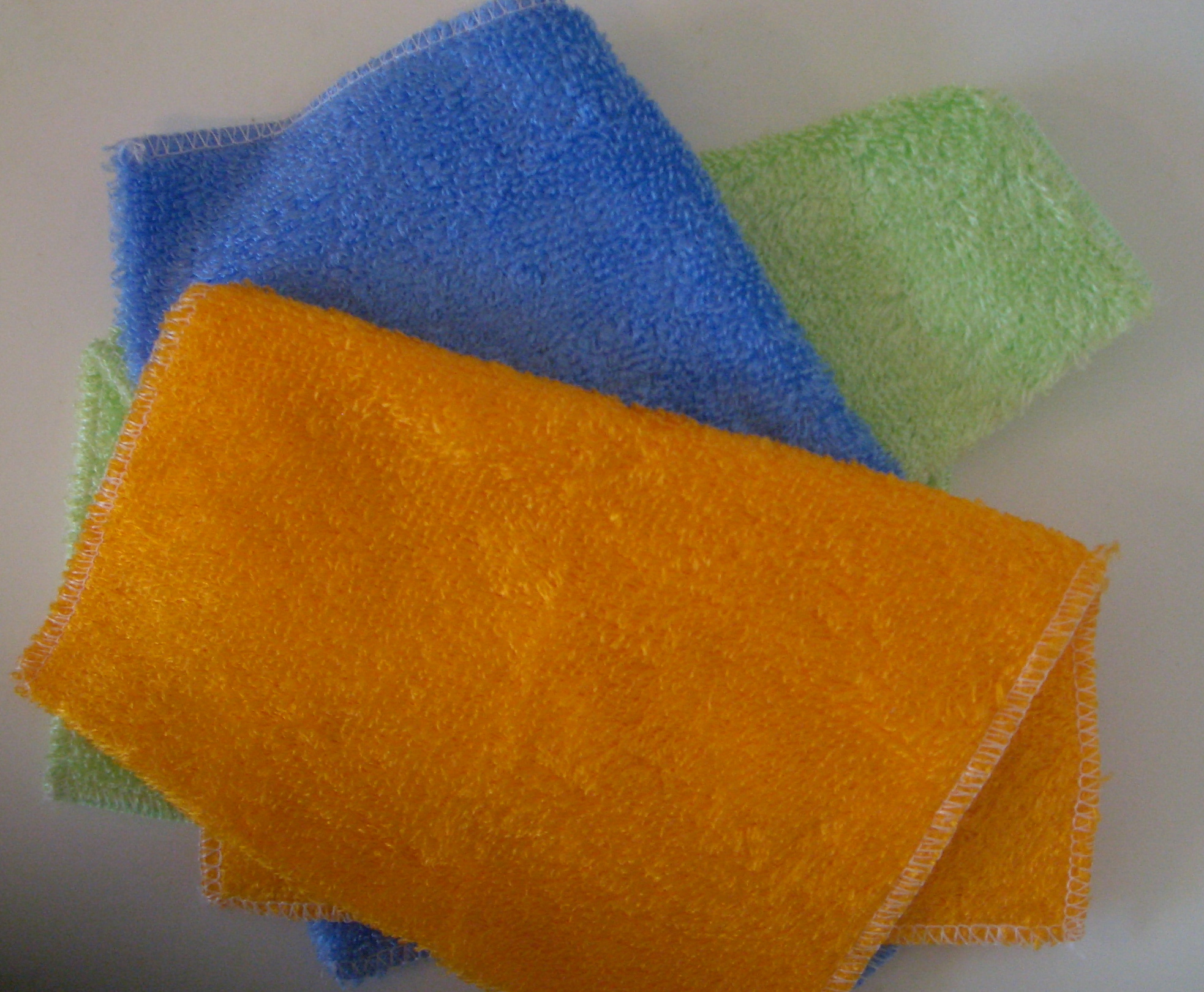
PRICE HK$ 40-55 for a pack of 4 cloths
PRODUCT RATING Pretty Good, without dish detergent, when used for washing dishes that are not too greasy. Just Ok, with detergent, for dirty dishes. Excellent when used for wiping countertops. A superior product for many uses, but does not replace a sponge with an abrasive pad for hard-to-clean dishes.
GREEN RATING Light Green to Quite Green depending on the manufacturing process chosen by company. Made from 100% bamboo fiber. Durable. The anti-bacterial quality of bamboo means you can go without detergent for light cleaning. (note: there is some controversy about whether the anti-bacterial quality of bamboo remains after going through the manufacturing process.) The Noesis brand cloth is certified organic.
AVAILABLE AT Club O. They are sold by two Hong Kong companies (Noesis is one, the other I can’t remember the name) usually at booths in malls or shopping areas. Also sold at Mai Po Po in Fan Ling during their local organic farmers market on Wed and Sun.
For wiping our dining table and kitchen counters, we used to use the ubiquitous Scotch-Brite Kitchen Wipes. These are the ultra-thin, blue striped, perforated cloths that seem to occupy every home. From a user perspective, I have always been dissatisfied with them. Firstly, they are too thin to be held properly when wiping something down and have a very unsatisfying, disposable feel to them. Then after a dozen or so uses, they get that squishy feel that is really quite gross. You start to wonder, what kind of germs are brewing in that moist, mushy cloth. The cloth then eventually starts to smell, as if to confirm your initial fears. Although they are advertised as washable, who feels like putting something like that in the wash with their clothes?
Since they are so cheap and because no one wants to wash them, I suspect most of us end up throwing them away before the end of their useful life. Minimizing the use of disposable items, that over a lifetime clog up our landfills, is a key principle of living sustainably. In addition, these wipes are produced from petrochemical derivatives making them inherently unsustainable.
We also avoided the use of a cotton dish cloths because cotton is one of the most environmentally unsustainable crops. Although advertised as natural, the growing of cotton today constitutes 25% of annual worldwide insecticide use, while only occupying 3% of agricultural land. The land on which conventional cotton is grown is a dead zone, no other plants, animals or insects can survive on it. Bamboo on the other hand grows rapidly and naturally without any pesticides, herbicides or fertilizer. It has a massive yield per acre and is probably one of the most sustainable crops in the world. Bamboo, like trees, also sequester CO2.
The bamboo cloths reviewed here are sold for washing dishes, but we also use them for wiping tables and countertops. For this use, they have many advantages that make them simply superior to both Scotch-Brite wipes and cotton cloths. The first thing you notice when you touch them is the thick, quality feel that just feels just right in your hand. They are soft and absorbent like cotton, but don’t get that super heavy feel when soaked with water. It’s like a cross between synthetic quick-dry and cotton. Continue reading “Bamboo Dish Pad & Wiping Cloth”
An Inspirational Guide to Building an Environmentally Sustainable Business

TITLE Let My People Go Surfing. The Education of a Reluctant Businessman
BOOK RATING An inspiring and useful guide for those seeking to build an environmentally sustainable business.
GREEN RATING Deep Green. Book is printed on Forest Stewardship Council (FSC) certified and recycled paper.
AVAILABLE AT Can be reserved online and sent to a public library near you for HK$ 2.50
For those who haven’t heard of Patagonia, there is a very good reason why: it simply does not promote its outdoor apparel to people that do not need them. This business philosophy stands out when the Timberlands and North Faces of the world are hawking their outdoor gear to city slickers that will use them mainly in the extreme conditions of IFC or Festival Walk. Patagonia’s products on the other hand are highly sought after by true outdoor enthusiasts.
This book by Patagonia founder, Yvon Chouinard, is truly a refreshing change from business books written by egomaniacs like Jack Welch and Donald Trump or by out of touch ivory tower academics. The title “Let My People Go Surfing” refers to the company flex-time policy that when the surf is up, you can drop what you’re doing and go surfing so long as you get all your work done properly. It is structured broadly into 3 sections: (1) “History” which reads like an autobiography; (2) “Philosophies” of product design, production, distribution, image, finance, human resources, management and environment provides practical guidelines enlivened by great stories; and (3) “1% For the Planet” which discusses the companies philanthropic initiatives.
Here are just a few examples makes Patagonia a Deep Green company:
1. It was the first company to recycle plastic drink bottles into fleece. Chouinard writes: “At the time of our fiber study, we were manufacturing a lot of fleece jackets made from virgin polyester, the only kind of polyester available. So we worked with a company called Wellman to find alternatives. They developed a process that takes soda pop bottles, which are also made of polyester, and recycled them into raw material for jackets. It takes 25 bottles to make a jacket, and from 1993 to 2003 we diverted 86 million soda bottles from landfills. For every 150 virgin polyester jackets that we replaced with post-consumer recycled polyester, we saved 42 gallons of oil and prevented a half ton of toxic emissions.”
2. Patagonia completely phased out the use of conventionally grown cotton in 1996. After visiting a cotton farm, Chouinard realizes the devastating effect of cotton farming on the land. Chouinard writes, “today 25% of the annual worldwide insecticide use and 10% of of the annual worldwide pesticide use are applied to conventionally grown cotton, even though cotton fields occupy less than 3% of the world’s farmland. Many of these chemicals were originally formulated as nerve gases for warfare, so it’s no surprise the higher rates of birth defects and cancer have been found in both humans and wildlife surrounding cotton fields.” Continue reading “An Inspirational Guide to Building an Environmentally Sustainable Business”
Local Organic Farmers Market
Pictured above: “Brother So” sells produce at Star Ferry Pier on Wed. PRICE HK$ 16-30 per catty (1 catty = 650g) depending on the market. Farmers at each of the markets generally charge similar prices. In contrast, supermarkets charge HK$ 15-17 per 250g for Mainland grown organic vegetables. Cheapest: Fan Ling. Most Expensive: Mei Foo. FOOD RATING Locally grown means produce is picked fresh, retaining more nutrients and … Continue reading Local Organic Farmers Market
Easy Change, Huge Impact: Part 2
PRODUCT NAME No Frills Toilet Tissues PRICE HK$ 17.90 for 10 rolls PRODUCT RATING Very little compromise when compared to conventional toilet paper. GREEN RATING Deep Green. Made from 100% Recycled Paper and Forest Stewardship Council (FSC) certified AVAILABLE AT Wellcome In our previous article about environmentally friendly toilet paper, we reviewed Green Soft, which did not perform as well as conventional toilet paper and is available only in a few … Continue reading Easy Change, Huge Impact: Part 2
 Go Green Hong Kong