




Sustainable Canned Tuna

PRODUCT & PRICE Marks & Spencer canned tuna steak HK$30(2nd from top)
PRODUCT RATING Tuna steak is much tastier than flaked tuna. However, all tuna should be consumed in moderate quantities due to mercury, from coal fired power plants, that accumulates in the flesh of many larger fish.
GREEN RATING Quite Green for not using endangered species and destructive fishing methods in its canned tuna products. M&S only uses skipjack in its canned tuna products. Unlike many other tuna species, the skipjack tuna population is considered sustainable against its current consumption. According to the Marine Conservation Society (MCS), skipjack tuna stock is neither overfished nor experiencing overfishing. M&S uses only pole and line catch method (no nets) which eliminates “bycatch”. Sharks, rays, marlins, turtles and other fish caught as bycatch are usually thrown back dead because they are the wrong species, the wrong size, of inferior quality or surplus to the fishing operation’s quotas. M&S is ranked #2 in Greenpeace UKs 2011 ranking of sustainable tuna products. John West is ranked #7, while other Hong Kong supermarket brands, such as Ayam, do not specify species or fishing method (labeling is the absolute minimum requirement to even be considered in sustainability rankings). Please remember to recycle your tins.
According to Australian Food News:
“The majority of canned tuna is caught using fish aggregation devices (or FADs) — floating and submerged objects that encourage tuna to gather around them. The fish are then scooped up in huge nets called purse seines.
Marine animals are killed or harmed in fishing operations without ever being brought on board. Species like turtles and dolphins get tangled in nets or hooked on longlines. Even those that escape are sometimes too injured or weak to survive the ordeal. Continue reading “Sustainable Canned Tuna”

Oh…So… Cool
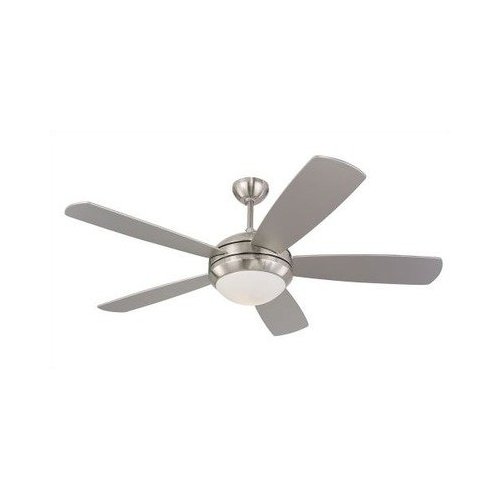
PRICE RANGE HK$ 400 to 3000. Installation may be extra (we paid HK$ 400 to have ours installed).
PRODUCT RATING Cooool. Fans cool you gently without making you vulnerable to colds. According to a study conducted by Cardiff University, “Air conditioning itself may contribute to infection with common cold viruses. The lining of the nose is covered with a thin layer of mucus which protects against infection. Since air conditioners extract moisture from the air they may cause some drying of the protective mucous blanket in the nose and predispose to infection. The cold air may also help viruses to establish a hold in the nose as they reproduce better in a cold nose”. Not to mention the havoc that is caused to your body when you walk into a freezing cold room after having been outside in the blazing heat.
GREEN RATING Quite Green. Fans consume only one-tenth the electricity compared to an air conditioner. However, due to the inconceivably poor design of Hong Kong apartments – with large, protruding bay windows that trap heat, windows that don’t open to allow ventilation, etc – fans can only be used primarily as a complement rather than a substitute for air conditioners. Fans are simple, durable devices. In comparison, air conditioners are complex to manufacture and dispose of safely. New air conditioners contain refrigerants (flourocarbons) that do not deplete the ozone layer, but still contribute to global warming because they are potent greenhouse gases.
AVAILABLE AT http://www.smcfans.com/products
Modern humans are comfortable within a fairly narrow temperature range – according to the EPD, over 90% of building occupants feel comfortable with temperature between 22.5C and 25.5C. In Hong Kong, where summer temperatures can easily rise above 30C, we face a conundrum – do we use an air conditioner to make ourselves cooler today, while pumping more greenhouse gases into the atmosphere that will guarantee a hotter climate for ourselves in the future?
One way we can try to maintain a cooler living environment while lessening our impact on the planet is to use fans. By installing a ceiling fan in our bedroom, we have been able to reduce the number of nights we turn on the air conditioner by about 30% (the two weeks at the beginning and end of summer). Even when we do use the air conditioner, we are able to able to set it at 26C. For every 1C increase in your thermostat setting – you reduce your electricity consumption by 3%. Continue reading “Oh…So… Cool”
Where to buy a cast iron pan?
Name of the store: Choy Tung Shing Address: 190, Reclamation St., Yaumatei, Kowloon, HK Phone: 2384 7856 Email:choytungs@yahoo.com.hk The cast iron pans are in the bottom part of the photo, right in the middle. Continue reading Where to buy a cast iron pan?
The Shark Fin Free Banquet
Thanks to the efforts of tireless individuals from organizations such as Bloom and Sea Shepherd there are many more shark fin free banquet options in Hong Kong. Bloom has been instrumental in working behind the scenes to help hotels and restaurants understand this issue, while Gary Stokes of Sea Shepherd has been fearless in his own unique approach. Studies show that predator shark species have all … Continue reading The Shark Fin Free Banquet
The Original Non-Stick
 PRODUCT Cast iron skillet
PRICE HK$80 for the 10.5″ pan
PRODUCT RATING Excellent for pan-frying, braising, searing and sauteing (and quite possibly as a weapon …it is very, very heavy). Due to the excellent heat diffusion and retention properties, you can get that sizzling golden brown, teppanyaki effect that just can’t be duplicated on a non-stick pan. I think it would be great for searing meat, although I haven’t tried it myself, as I stopped cooking meat a few years ago.
GREEN RATING Deep Green. I’ve only owned it for a short time, but have a feeling that it will last forever. This is just so much greener than throwing a non-stick pan into the landfill every 6 months.
AVAILABLE AT We bought ours at a cookware shop on Shanghai Street (Yau Ma Tei MTR). There are various brands at different price ranges available at kitchen shops around the city.
Yvonne Chounard, Patagonia’s founder, defined a well made, well designed product as one that lasts a long time, is easily repaired and then finally breaks down in many places at the same time. For example, a pair of Levi’s lasts many, many years, but when its seen too many days, it gets holes in the knees, frays at the bottom, small change falls through the pockets all at the same time. He defined a poorly designed product as one where if one part breaks, the whole thing is trashed. For example, if one tiny part in our stereo, TV, or computer breaks we end up throwing the whole thing away.
Based on this definition, non-stick pans are pretty poorly designed. After 6 months of use, the pan still looks fine, but because the non-stick coating is worn, the whole thing has to be thrown away. I’ve tried many brands from Meyer to Tefal to Silverstone and they all end up in the trash within a year. I end up buying a new pan every year and throwing my old one into the landfill. Continue reading “The Original Non-Stick”
30 Seconds Can Make a Difference

“We did not inherit the Earth from our ancestors, but have only borrowed it from our children” – Native American proverb
“What gets measured gets done” – business maxim
WHAT IS THIS ABOUT?
HKEX is holding a Public Consultation that “seeks views and comments on the proposed ‘Environmental, Social and Governance Reporting Guide’ (the “ESG Guide”) for issuers [companies] listed in Hong Kong”.
WHY IS THIS IMPORTANT?
If you are reading this, you are probably already aware of the seriousness of the environmental problems facing us all. As enlightened consumers, we cannot solve these problems on our own. Government and corporations must do their part. Through the Public Consultation process, we as citizens must make our voices heard and demand that they do their part. Democracy and civic society is like a muscle, if we don’t use it, it will shrivel up. If we do not participate when given the opportunity, we cannot complain, “government only listens to business”.
According to the HKEX “a company is taken to be responsible for its impact on society and the environment. A company should operate in a sustainable manner and create long-term value for shareholders and other stakeholders by integrating sustainable practices into its operations.” We could not agree more.
WHAT IS THE HKEX PROPOSING THAT WE DISAGREE WITH?
The HKEX is proposing to make environmental reporting VOLUNTARY because they believe it is “premature” at this time to make it compulsory. However, they give no reason why it is premature other than “many issuers may not consider ESG performance and reporting a priority”. Any elementary school teacher can tell you that if you make homework voluntary, it will certainly not be a priority for the students. This is completely circular logic.
WHAT ARE WE PROPOSING?
Demand COMPULSORY reporting or at a minimum raising the level from voluntary to “obligation to comply or explain” why they are not complying with the reporting requirement.
WHAT CAN YOU DO?
If you agree that environmental and social responsibility reporting needs to be compulsory, please copy and resend the following before 9 April 2012: Continue reading “30 Seconds Can Make a Difference”
The Right Water Bottle for You
It would be an extreme understatement to call the garbage created by bottled drinks a serious problem. In Hong Kong, less than 4% of disposable plastic (PET) drink bottles are recycled and Coca-cola owned brands alone produce 1 million bottles a day (you read that right, it’s per day). These bottles end up in the landfill or worse yet in the ocean. According to National … Continue reading The Right Water Bottle for You
The Library 2.5
This book sells for HK$400 at Dymocks. With a few clicks I had it delivered to my neighborhood library for HK$2.50 and kept it for over 2 months for free.
SERVICE RATING Awesome. The public library’s selection is unparalleled and vastly superior to those of Hong Kong’s closet-sized bookstores. The online search, reservation and renewal functions work great. The reservation function allows you to have a book delivered, no matter which branch it’s currently in, to the one closest to you. There are after hours book return drop boxes outside every branch and at Central, Kowloon Tong and Nam Cheong MTR stations.
GREEN RATING Deep Green. Much greener than buying a book you’ll likely only read once and infinitely greener than downloading books to your Kindle or iPad (explained below).
OPENING HOURS and LOCATIONS here
The US media has proclaimed the sharing revolution to be the next big thing. From Zipcar to Netflix it’s taking hold all over the US. The public library though has been sharing since forever.
BORROWING VS. OWNING
Buying books has three distinct disadvantages that borrowing from the library overcomes. Often times you simply don’t know if a book is good or not. Just like you wouldn’t commit to marrying someone after a first date, you probably don’t want to commit to spending the time and money to buy and read a book after only perusing a few page. Second, once you own it, it ends up taking up precious real estate in your space deprived Hong Kong apartment. Lastly, it’s a pain to pack up every time you move. For me, these practical drawbacks simply outweigh any psychic pleasure I gain from owning a book.
ENVIRONMENT
Many trees are chopped down in the process of making books while much fossil fuel is burned transporting them. It is often suggested that iPads or e-readers, such as Amazon’s Kindle, offer a solution. Unfortunately, these devices and the gear that supports them are an environmental disaster. The environmental impact resulting from the manufacture and disposal of electronics, which are replaced on average every 3-4 years, has been well documented. According to Time, “A lot of exported e-waste ends up in Guiyu, China, a recycling hub where peasants heat circuit boards over coal fires to recover lead, while others use acid to burn off bits of gold. …Guiyu has the highest level of cancer-causing dioxins in the world and elevated rates of miscarriages.”
A hidden but no less damaging consequence of the online revolution has been the massive amounts of energy consumed to run all that high tech gear. Data centres, networks and PCs collectively consume unbelievable amounts of electricity. At a PolyU Energy and Environment conference I attended, one of speakers asked the audience the following question “What is the best option [from an environmental perspective] of transporting a dozen books from Australia to Hong Kong within 24 hours: (a) ship them via air, (b) download them to your e-reader or (c) burn them onto some disks and then ship them by air? As you probably guessed, it turns out to be (c). What is surprising though is that (a) actually has lower carbon emissions than (b) due to all the energy required to run data centres and networks 24 hours a day and move data at lightspeed. Continue reading “The Library 2.5”
Fresh is Best
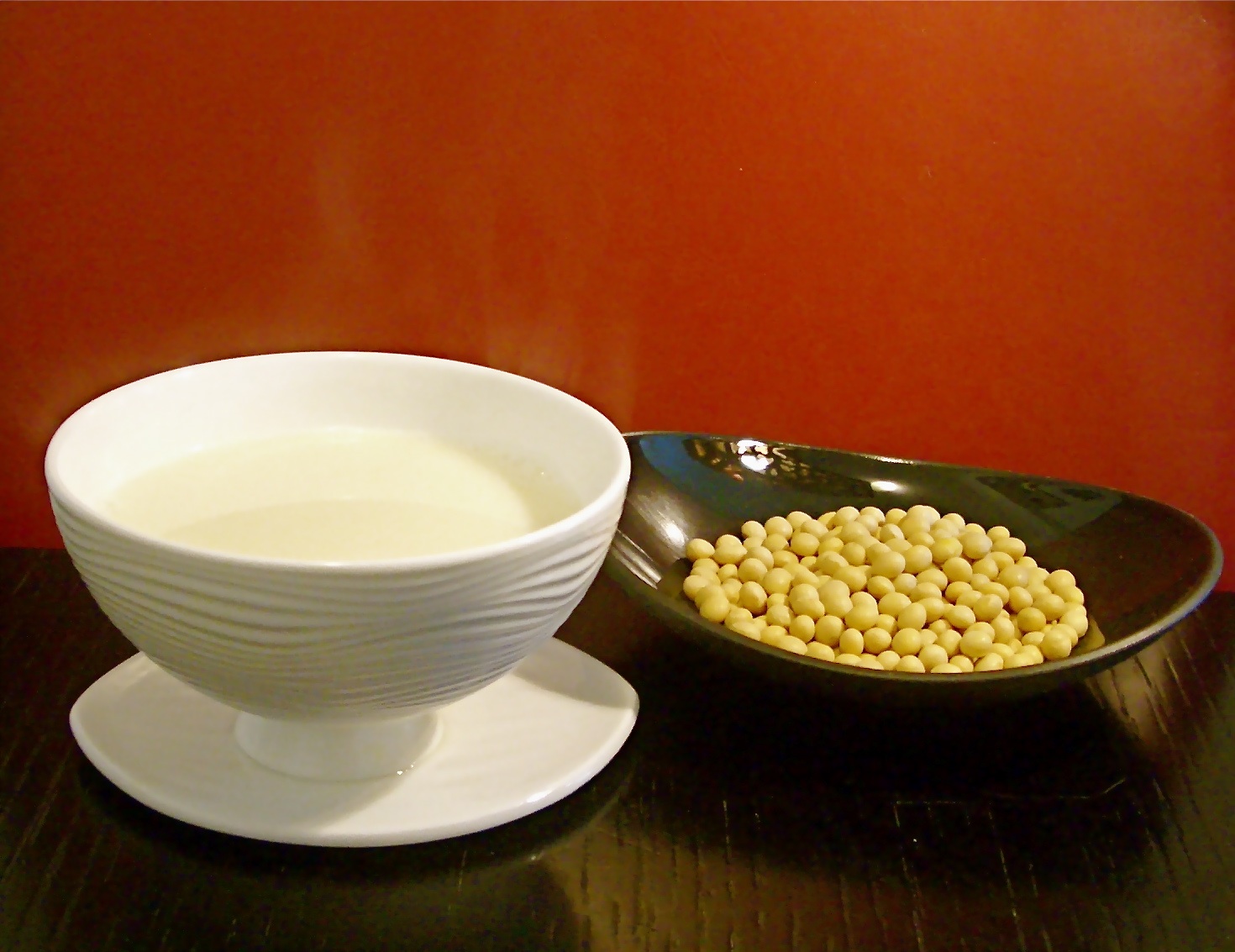
PRICE Organic soya beans HK$ 28 for 2 pounds (HK$ 30.8 per kg). Non-organic soya beans HK$ 7 per catty (HK$ 11 per kg). 1kg of soya beans makes about 3 litres of soya milk.
PRODUCT RATING Very Good. Homemade soya milk is fresh and delicious. No additives means it’s healthier for you. You can sweeten it to suit your taste. Easy to make and worth the effort. Economical. Very healthy, according to the US FDA:
“Soy protein products can be good substitutes for animal products because, unlike some other beans, soy offers a “complete” protein profile. Soybeans contain all the amino acids essential to human nutrition, which must be supplied in the diet because they cannot be synthesized by the human body. Soy protein products can replace animal-based foods–which also have complete proteins but tend to contain more fat, especially saturated fat–without requiring major adjustments elsewhere in the diet.”
GREEN RATING Deep Green if made with organic soya beans or consumed as a dairy milk replacement (note: it does not mix well with coffee). Quite Green if made using conventional (GM) soya beans. Soya milk has a much lower carbon footprint than dairy milk. Homemade soya milk reduces that even further because less fossil fuel is used in transportation (liquids are heavier) and refrigeration is not required. In addition, there is no carton to dispose of.
AVAILABLE AT Organic soya beans are available at various health food stores. The price quoted above is from Green Concepts. Conventional soya beans are available in the wet markets.
As part of our effort to reduce our dairy consumption by 50%, we started drinking more soya milk. We began by buying organic soya milk in cartons. However, after researching all the additives in the ingredient list we became concerned. Vita brand soya milk, for example, contains a glazing agent to make it look brighter that is also used in shoe and car polish.
From an environmental perspective, we found the need to manufacture and dispose of single use cartons, and the high carbon footprint required to transport and refrigerate it quite troubling. Searching for an alternative we began making our own soya milk. Here’s how we make it: Continue reading “Fresh is Best”
Sometimes Green, Not Always Clean
We have tried many detergents in an attempt to reduce the impact of doing our laundry on the environment. According to this report by the US EPA on the Key Characteristics of Laundry Detergent Ingredients, many conventional laundry detergents contain substances that:
- Are toxic to aquatic organisms like fish and algae
- Are endocrine disruptors in animals, including humans
- Diminish oxygen levels in water and hence reduce the water body’s ability to support aquatic life (phosphates)
- May cause cancer or other adverse health effects in humans
One of the most effective ways to reduce the impact of doing laundry is to minimize the amount of washing we do and to use less detergent. For example, towels, bedding, sweater and jeans don’t require heavy duty cleaning. For these items, we can cut our detergent use in half. According to the WSJ, many fashionistas are in fact washing their jeans as little as possible and are instead hanging them up to air out.
We hesitated somewhat before writing this article because without a testing lab, it can be quite hard to tell when clothes are clean. Our highly “scientific” method includes visually inspecting and smelling our laundry after a wash. Here is a review of the cleaners we have tried:

PRODUCT Ceramic Pieces Washing Ball (Korea)
PRICE HK$ 400 – 500
PRODUCT RATING Useless. The plastic ball contains ceramic pellets which supposedly change the pH balance of the water to wash your clothes without detergent. However, Consumer Council’s “Choice” magazine conducted lab tests that show that using it is no more effective than washing with water alone.
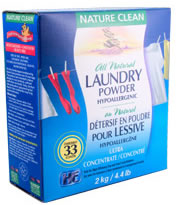
PRODUCT Nature Clean Laundry Powder (Canada)
PRICE HK$ 80 for 2kg
PRODUCT RATING Very good. Clothes look and smell clean. Results are very similar to conventional detergents. Has a very pleasant smell. Highly concentrated so only a small amount is required. Lasts a surprisingly long time for such a small box.
GREEN RATING Quite Green. Does not contain phosphates, chlorine bleach, synthetic dyes & perfumes, or optical brighteners. Formula is vegetable based derived from corn and palm kernel oil. The demand for palm oil though is a cause of deforestation of tropical rainforests. Powders are more concentrated than liquids, hence require less energy to transport. This may be somewhat offset by the fact that it is produced in the Canada. Packaged in a recycled cardboard carton.
AVAILABLE AT Club O in Mong Kok
 Go Green Hong Kong